Indonesia: a first-timer's guide to seventeen thousand islands
The ferry to Nusa Penida is late, nobody minds, and a man beside you is carrying a rooster in a cardboard box. Somewhere behind, a volcano you cannot name is putting out a thin line of smoke. Indonesia does this constantly: it is so large, and so various, that whatever picture you arrived with turns out to be one island's worth of a country that has more than seventeen thousand of them.
It spans three time zones and around 1,300 ethnic groups, and the distance from the western tip of Sumatra to the Papuan border is roughly London to Tehran. Trying to see it in a fortnight is the classic first mistake. Pick two islands, go slowly, and let the scale impress you rather than defeat you.
Best time to visit
Most of the country runs on two seasons rather than four. The dry season, roughly April to October, is the straightforward time to travel: reliable sun, calm seas for crossings, and the best conditions for climbing a volcano before dawn. The wet season, November to March, brings heavy afternoon downpours rather than constant grey, along with green landscapes, thinner crowds and lower prices. July and August are peak, and Bali and the Gilis feel it.
The pattern flips as you go east. Raja Ampat in West Papua is calmest and clearest from October to April, precisely when Java and Bali are wettest, so a diving trip there wants the opposite calendar to everything else. Ramadan shifts by around eleven days a year and changes the rhythm of Muslim-majority regions: many restaurants close during daylight, but evenings become the best street food of the year.
Where to go
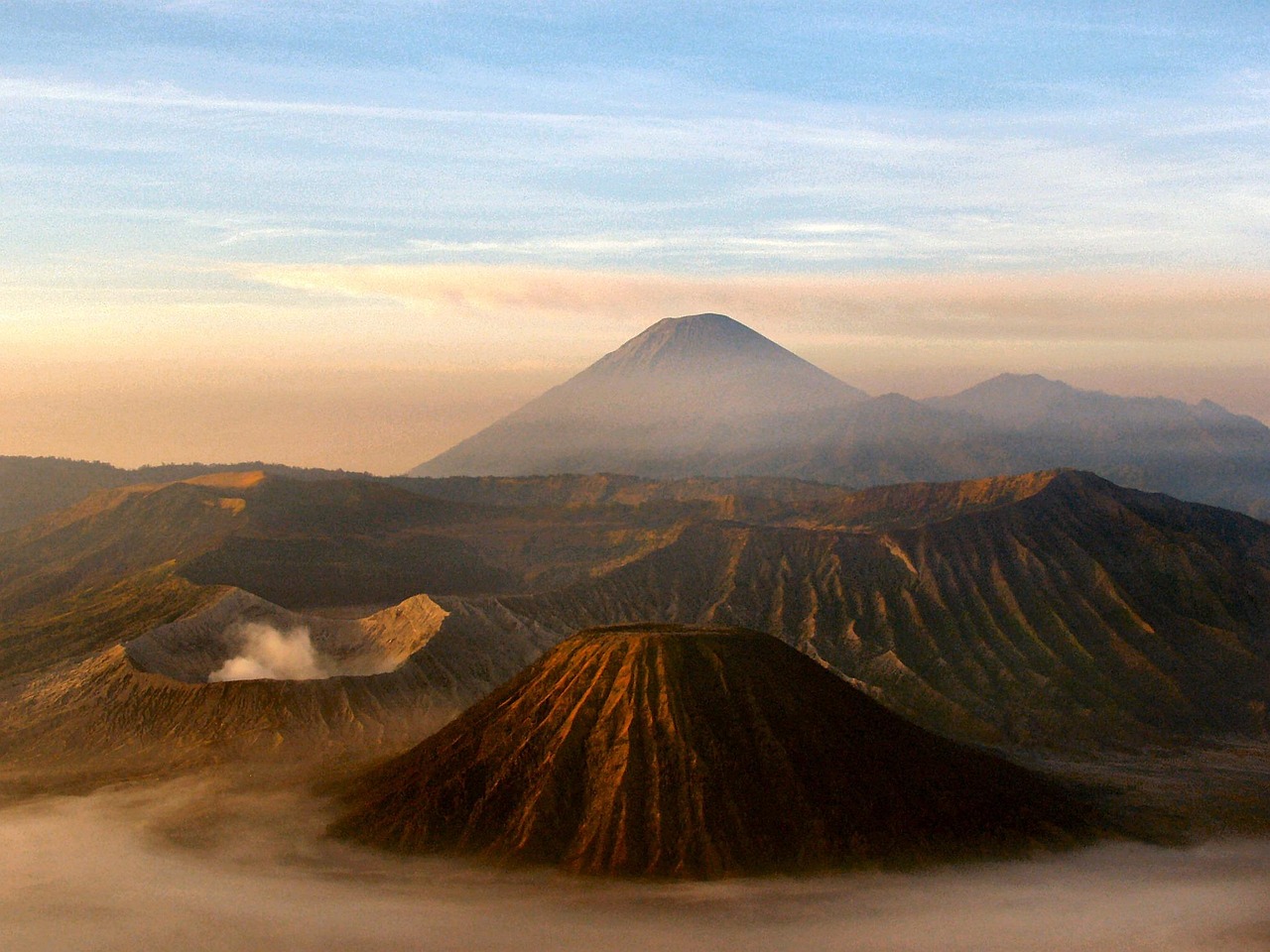
Java holds most of the population and the majority of the history. Yogyakarta is the cultural heart, a city of batik workshops and gamelan within reach of two extraordinary temple complexes: Borobudur, the largest Buddhist monument in the world, and Prambanan, its soaring Hindu counterpart. East Java delivers the volcanoes people come for, the caldera views at Bromo and the blue sulphur fires of Ijen, both of which mean a very early start and genuinely cold air.
Bali rewards far more time than the airport transfer to Seminyak suggests. Just east, Lombok is quieter, with Rinjani for trekkers and the three car-free Gili islands offshore. Further east, Flores is the gateway to Komodo National Park and its dragons, with the coloured crater lakes of Kelimutu inland.
Further from the crowd, Sumatra offers orangutans in the forest at Bukit Lawang and the vast volcanic caldera of Lake Toba, while Sulawesi has the cliff-carved tombs of Tana Toraja and superb reefs off Bunaken. Raja Ampat, hard to reach and expensive to dive, is regularly named the richest marine environment on the planet. One rule is worth remembering: Indonesia rewards depth over distance.
Getting around
Domestic flights do the heavy lifting. Garuda Indonesia is the full-service carrier, with Citilink, Lion Air, Batik Air and Super Air Jet covering an enormous network cheaply. Book with a little slack in the schedule, because delays are ordinary and a missed connection on the far side of an archipelago is a genuine problem.
Java is the exception, and its trains are a pleasure: clean, punctual and far more scenic than flying, with the Jakarta to Yogyakarta run one of the great value journeys in Asia. Book through the official Kereta Api channels. Between islands, Pelni runs long-haul passenger ships and local ferries handle the short hops, though crossings are cancelled in rough weather and small fast boats are not always as regulated as you might hope.
In towns, Gojek and Grab are indispensable. Both do cars and motorbike taxis, and both settle the price before you get in, which removes the whole negotiation. Traffic in Jakarta and south Bali is genuinely severe, so a motorbike is often three times quicker than a car. Indonesia drives on the left. If you intend to ride, bring an international driving permit with the motorcycle category, wear a proper helmet, and be honest with yourself about whether a busy Balinese road is the place to learn.
Where to stay
Value here is remarkable at every level. Family-run homestays offer a clean room and breakfast for very little, and the middle is where Indonesia really shines: small guesthouses with a plunge pool and an owner who will arrange your driver for the day.
In Yogyakarta, Prawirotaman is the traveller quarter. In Java's cities, pick for proximity to a station rather than a view. Around Bromo, staying in Cemoro Lawang saves a punishing pre-dawn drive. On the islands, choose the coast before the hotel: the wrong bay can cost you a morning. Book well ahead for July, August and the fortnight around Christmas.
What to eat
Eat at warungs, the small family kitchens that serve one thing properly. Nasi goreng and mie goreng are the everyday staples, but the real depth is regional. Rendang, the slow-cooked dry beef curry from West Sumatra, is routinely voted one of the best dishes in the world and is nothing like the version served abroad. Padang restaurants are their own experience: a dozen small bowls arrive unbidden, you eat what you want, and you pay for what you touched.
Look for sate in all its variations, gado-gado with its peanut dressing, soto in a hundred local forms, and bakso meatball soup sold from carts you hear before you see. Martabak, sweet or savoury, is the great late-night indulgence. Sambal is not optional; ask for it on the side if you are cautious. Coffee is superb, though kopi luwak involves caged civets in most commercial operations and is best avoided. Eat and pass with your right hand, and drink bottled or filtered water rather than tap.
Culture and courtesy
Indonesia is the largest Muslim-majority country in the world, and also home to Hindu Bali, Christian communities in Flores, Papua and North Sulawesi, and older traditions that predate all of them. Courtesy travels well between them: dress modestly away from beaches and resorts, cover shoulders and knees at any place of worship, and take your shoes off when the shoes by the door say to.
Use your right hand for giving, receiving and eating, since the left is considered unclean. Do not touch anyone's head. Point with an open hand or a thumb rather than a finger. Public displays of temper achieve nothing and cost you the goodwill of everyone watching. Aceh province operates under sharia law, with stricter rules on dress and alcohol than the rest of the country.
Practical essentials
Most visitors, including UK travellers, need a visa. The usual route is the Visa on Arrival, currently 500,000 rupiah for 30 days and extendable once for another 30. You can pay on landing or apply in advance as an e-VoA on the official immigration portal, which lets you skip the arrivals queue. Your passport must have at least six months of validity. There is also an electronic customs declaration to complete shortly before you land. Rules here change more often than most, so check the official Indonesian government sources rather than an agency that charges for a free service.
The rupiah runs to a lot of zeros and it takes a day to stop misreading notes. Draw larger amounts less often, because foreign-card ATM fees are charged per withdrawal, and keep cash for warungs and markets. Power is 230V with the European two-pin plug. Indonesia sits on the Ring of Fire and eruptions do disrupt flights, so build slack into any itinerary built around volcanoes.
Staying connected. Coverage is strong across Java, Bali and the main cities, with fast 4G nearly everywhere and 5G in the bigger centres, but it thins quickly in the highlands, on small islands and across Raja Ampat and interior Papua. Indonesia sits outside the inclusive roaming allowances on most UK plans, so leaving your usual SIM switched on gets expensive fast. There is also a wrinkle worth knowing: Indonesia enforces IMEI registration for devices on local networks, which is handled at the counter for short stays but has caught out longer trips. Devices on international roaming are explicitly exempt from that process, so an eSIM from idealesim avoids it entirely. Install it over Wi-Fi before you fly and land with data already running for Gojek, ferry times and maps. Download offline maps for anywhere remote.
Bahasa Indonesia is one of the easier languages to make a start in: no tones, no verb conjugation, a Latin alphabet, and plurals made by saying the word twice. Terima kasih for thank you, selamat pagi for good morning, and berapa harganya for how much, will all be met with real warmth.
Two islands, properly
The travellers who love Indonesia are almost never the ones who saw the most of it. Choose two islands, book the extra nights, and let a slow ferry and an unhurried lunch do the rest.
Not travelling yet?
Tell us your travel date and we will email you before you go (a week before, or when you choose) with the latest Indonesia eSIM prices. No account needed.