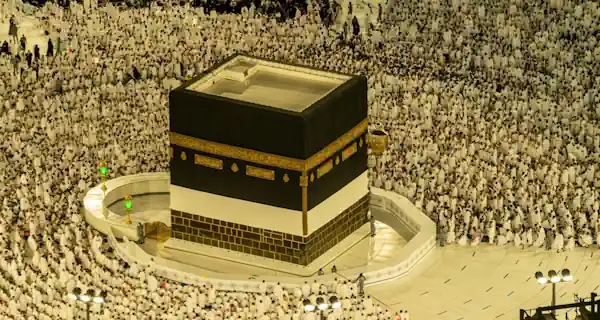
Hajj and Umrah: a connectivity guide for pilgrims to Makkah and Madinah
For Muslims, Hajj is one of the five pillars of Islam — the obligation to make the pilgrimage to Makkah once in a lifetime, for those with the physical and financial means. Each year, around the month of Dhul Hijjah, two to three million pilgrims converge on the city for a few days of deeply meaningful rites.
If you're preparing for Hajj or Umrah this season, this guide is for the practical side of being far from home in cities you may not know well, where you'll need to navigate, communicate and reassure your family back home.
Hajj, Umrah, and what makes the season different
Hajj takes place once a year, during the month of Dhul Hijjah, and follows a fixed sequence of rites over five days at specific locations around Makkah — Mina, Arafah, Muzdalifah, the Jamarat, and the Tawaf and Sa'i at the Masjid al-Haram. Every able Muslim is required to perform it once in their lifetime, if they have the means. It is the moment the global Muslim community converges on a single point on the map.
Umrah is sometimes called the "lesser pilgrimage". The core rites are similar — Tawaf around the Ka'bah, Sa'i between Safa and Marwa — but Umrah can be performed at any time of year, takes a few hours rather than days, and isn't obligatory. Many pilgrims pair the two: arriving a week or two before Hajj to perform Umrah first, or staying on afterwards to do Umrah as a personal devotion. Most Hajj travel packages include both.
Most pilgrims also make time to visit Madinah, around 450 km north of Makkah, to pray at Masjid an-Nabawi. Hajj groups commonly split the trip roughly evenly between the two cities.
Why mobile data matters during the trip
The spiritual focus of Hajj and Umrah doesn't sit comfortably alongside constant phone use, and that's how it should be. But there are a handful of practical things almost every pilgrim relies on data for:
- The Nusuk app — Saudi Arabia's official Hajj and Umrah platform now handles permits, transport timings, and access to specific sites. You'll need it to load on demand throughout the trip.
- Reassuring family — a quick WhatsApp or video call so loved ones know you've arrived safely, completed Tawaf, made it back from Arafah.
- Maps — Makkah and Madinah are unfamiliar cities for most visitors. Finding your hotel after a long day at the Haram is where you'll really want a working map.
- Translation — for conversations with fellow pilgrims, asking directions, or reading Arabic-only signage.
- Group coordination — most people travel with a Hajj group and a designated leader. WhatsApp groups are how everyone stays in sync, especially when separated in crowds.
- Government and airline apps — Tawakkalna, Absher, your airline's check-in app for the return leg.
What to know about Saudi networks during Hajj
Saudi Arabia has three main carriers — STC, Mobily and Zain — and coverage in Makkah and Madinah is generally excellent. Our eSIM connects you to the strongest available local network on arrival.
One honest caveat: during the peak Hajj days (8–13 Dhul Hijjah), the network around Mina and Arafah carries an extraordinary load. Two to three million people in a small valley, all trying to call home at sunset on the Day of Arafah, will test any network in the world. Speeds can drop and messages can take longer to send. A few practical workarounds:
- Send shorter voice notes or text messages instead of video calls during the busiest hours.
- Pre-download maps of Mina, Arafah and Muzdalifah on Wi-Fi before you set out.
- Agree a time and meeting point with your group in advance, in case messages don't come through immediately.
Outside the peak rites, in central Makkah and Madinah, the network is stable and fast.
Which plan suits which pilgrim
A rough guide based on typical itineraries:
- Umrah trip, 5–10 days: a 1 GB / 7-day plan is enough if you're on hotel Wi-Fi most evenings and using cellular mainly for maps and messaging.
- Standard Hajj package, 10–15 days: a 3 GB / 15-day plan covers most pilgrims comfortably, including some video calls home.
- Full Hajj plus Umrah, 21–30 days: 5 GB or 10 GB over 30 days — the difference is mostly how often you'd like to call family on video.
- Hajj group leaders: 10 GB / 30 days. You'll be coordinating constantly, sharing locations, and helping pilgrims who don't have their own data.
If you're travelling on a multi-country itinerary that includes another Gulf state on the way, our Gulf Region plans cover Saudi Arabia alongside the UAE, Qatar, Bahrain, Kuwait and Oman on the same eSIM.
Practical tips for pilgrims
- Install your eSIM before you fly. Set it up on home Wi-Fi a day or two ahead, label it "Saudi Arabia", and toggle it on the moment you land — no queueing at the airport SIM kiosk after a long flight.
- Keep your home number active. Your home SIM stays on alongside the eSIM, so two-factor codes from your bank and family WhatsApp messages still reach you on your normal number.
- Download the essentials in advance. Quran app, prayer-time app, dhikr counter, offline maps. Anything that can work without data should — the less you depend on cellular during peak hours, the better.
- Charge ahead, carry a power bank. Long days at the Haram make battery life matter more than data. A good power bank is worth its weight.
- Respect the moments. The advice from those who've gone before is to put the phone away during Tawaf, Sa'i, and the standing at Arafah. The data plan is a tool for the practical bits — not the spiritual ones.
Ready to set off
If you've already booked your trip, browse our Saudi Arabia plans to find the right size for your itinerary, or use the Find My Plan wizard if you'd rather answer a few quick questions and get a recommendation.
From all of us at idealesim, may your journey be safe, accepted, and easy. Hajj mabrur.